Put your prices on your website
About a quarter of what an AI tool says about your business comes from your own website. If you don't have a pricing page, something else fills the gap.
If you ask Claude (or your agent of choice) how much it costs to paint the interior of a three bedroom house in Auckland, or what a property lawyer charges to handle a first home purchase, you will notice a pattern in which businesses get named. What you will find is that the businesses that come back are rarely the biggest or the cheapest ones in the market, they're the ones who've published what they charge.
I believe that publishing pricing has quietly become a really important part of getting citations (mentions or links to your website) from LLMs like Claude and ChatGPT and most of the owners I talk to are still resisting it for reasons that made a lot of sense four or five years ago.
What's changed about the way people ask about price
The best New Zealand data on this comes from the IAB's Commerce and Discovery Report, published in July 2026 off a nationally representative sample of 877 New Zealand online shoppers. It found 55% now use AI powered tools at least sometimes, rising to 61% among 18 to 39 year olds, and 93% still use search engines or online stores to research a purchase, so nothing has fallen off a cliff.
There's one number I keep coming back to from that study: 76% of shoppers said they use AI summaries to get a quick answer and then visit websites for the details. The summary is doing the shortlisting, and the website visit still happens, but of course that visit to your website will come if and when your business is cited.
You probably get the picture and I don't need to convince you further that it's important to get your website cited by AI engines, but just in case…
PwC New Zealand ran a survey with Ipsos in May 2026 across 1,000 New Zealanders who had already used AI for shopping, and among that group 64% use it to compare products and prices while 44% said it had reduced how much they use a search engine.
Your own website is a smaller part of the answer than you'd expect
Omniscient Digital published an analysis in January 2026 of 23,387 citations across 240 queries where a brand was named explicitly. When someone asks an AI tool about a business by name, the brand's own website accounted for 23% of what got cited. Editorial coverage, forums, review sites and directories made up 48%, and content written by competitors or sitting in third party listicles made up the other 30%.
So roughly three quarters of what comes back about your business is assembled from material you don't control. The slice you do control is your own site, which makes what's actually on it worth more than it used to be.
Who is doing this well? The businesses winning these answers are the ones being specific
The flooring company example
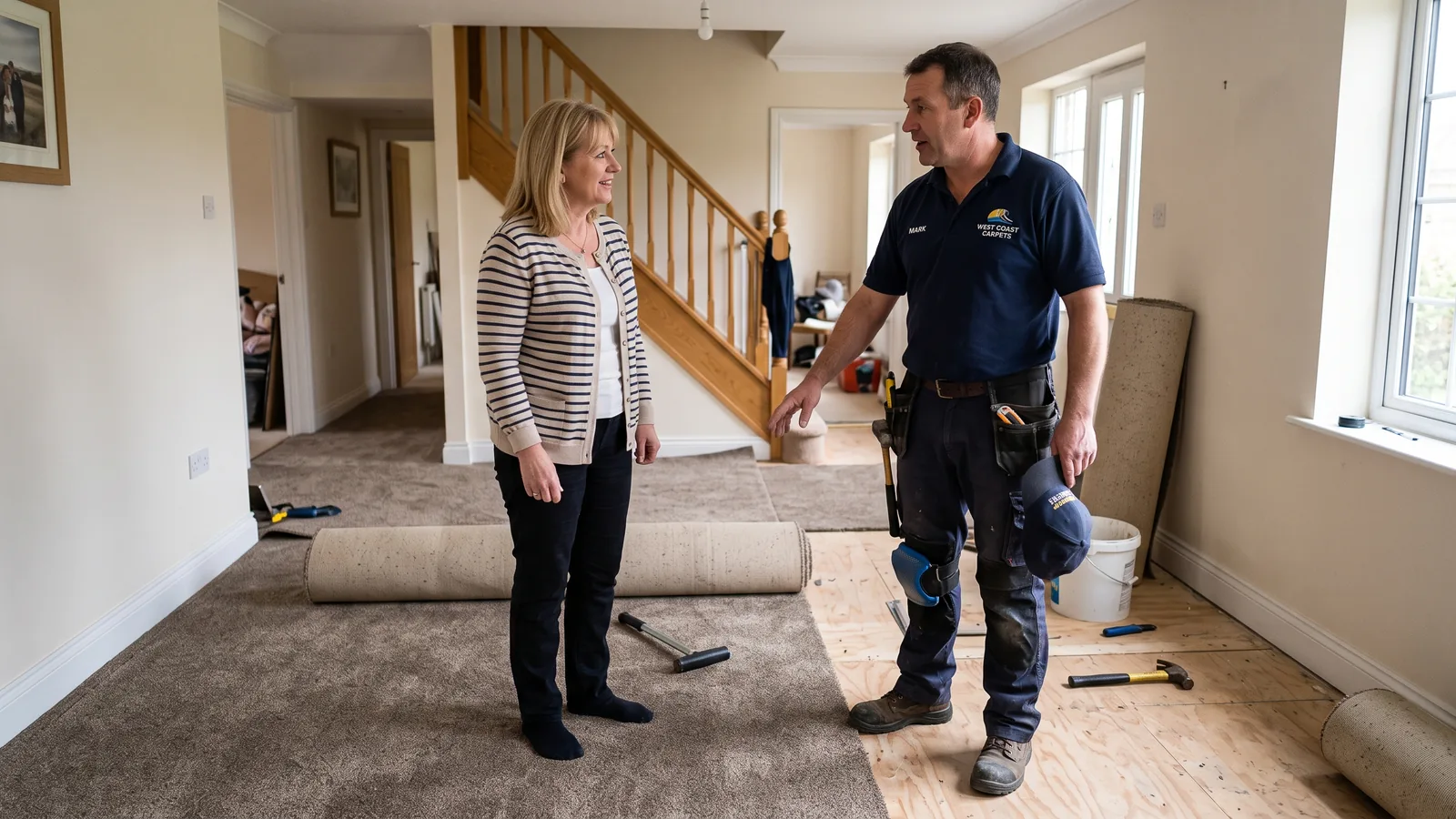
Flooring Design is a good example of this done simply. They've got a page answering what it costs to carpet an average New Zealand home, and rather than dodging the question they say $5,000 to $10,000, with installation running $50 to $90 or more per square metre. While it is a wide range, it's still useful for someone looking for an initial gauge on pricing.
Pro tip: The range comes with the reasons behind it, so when an AI tool repeats your pricing it repeats the conditions too and in the event of a customer quoting it back at you six weeks later you can point at your own page.
The property law example
Property law is the other one worth looking at because it's a category where everyone assumes pricing has to be bespoke every time and some firms have decided otherwise. The Property Law Centre in Auckland publishes fixed fees: $2,290 for a purchase with a mortgage, $2,090 for a sale with one mortgage discharged, $1,595 for a refinance, with GST and Land Information New Zealand disbursements included and a $150 anti-money laundering compliance fee on top.
The clever part is what they do next, which is to point out that competitors tend to advertise the professional fee on its own and add GST and disbursements afterwards. That turns a pricing page into an argument for choosing them, and it's hard to do that from behind an enquiry form. Well played!
Tiered "from" pricing is the version most people haven't considered
The objection I hear most often is that the work varies too much to put a number on it, and that's usually true (it's the same for us at Mint) which is why the useful version is tiers rather than a single figure.
You can generally build out three tiers, named the way a customer would describe them rather than the way you'd describe them internally. Using the flooring example, I'd go for something like rental grade for the hard wearing option that does the job, family home for the middle where most people land, and high end for customers shopping at the top of the market. Say what sits in each one, give it a range, and add a line about what pushes a job toward the top of its range.
Nielsen Norman Group worked this out a long time ago, back in December 2013, when their usability studies found that business buyers named pricing as the single most needed piece of information on a website, that participants left for a competitor's site when it wasn't there, and that people read companies hiding their costs as evasive. They also found that complicated pricing calculators mostly failed users while sample prices for typical scenarios worked well.
But what if I don't want to compete on price?
Publishing a number and competing on price are two different things and some of the businesses doing this best are the high end ones.
Keep in mind, dear reader, that the price conversation happens with or without you, and the only thing you control is whether you're in it. If somebody asks what it costs to curtain a lounge in Christchurch, they're getting an answer regardless, assembled out of whoever did publish something. The comparison happens either way, and if you've published nothing it happens against a benchmark you had no part in setting.
If you sit at the top of your market, the most useful thing to publish is often a floor rather than a range. Something like "most of our projects start at $15,000" tells one kind of customer they're in exactly the right place, and tells everybody else, kindly and immediately, that they're not. That's a positioning statement doing the work of a qualifying phone call, and it saves you the three quotes a month you were never going to win anyway.
Could we compromise here?
If your work genuinely varies too much for a range, publish the parts that don't. A design fee, a consultation, a measure and quote, a minimum engagement, or a typical band based on the last twenty jobs you did. Any of those answers the question honestly without committing you to a number on a job you haven't seen.
But my competitors will see it
They already know. Anyone can ring your office pretending to be a customer and in most trades the numbers get compared over a beer regardless. I couldn't tell you how many times a client has given us pricing from another marketing agency. Juicy stuff! The people your pricing page is genuinely for are the ones sitting at a laptop deciding whether you're worth an enquiry, and there are a great deal more of them than there are competitors.
There is a real version of this objection though: If publishing a number would drop you into a race to the bottom because nothing separates you from the next five businesses in your category, then pricing isn't the first thing to fix. That's a distinctiveness problem, and it'll cost you margin whether or not the numbers are public. Our brand and strategy team would love to help you!
Speaking of our team, if you are feeling a little overwhelmed by the world of AI and how it's affecting your marketing and your business, contact us. Tim, our Commercial Director, loves to talk shop over coffee. There's no obligation or pushy pitches - we just genuinely love to talk about business.
P.S. Tim also loves to talk about classic cars and how fast he is at running.
Tim Jones
Commercial Director
021 507 286
tim.jones@mint.co.nz
Sources
- IAB Australia and New Zealand with Pureprofile, Commerce and Discovery Report, published 6 July 2026, nationally representative sample of 877 New Zealand online shoppers. https://www.iab.org.nz/news-resources/new-research-how-kiwi-shoppers-are-discovering-and-buying-in-2026
- PwC New Zealand with Ipsos, The AI-powered consumer: How shopping behaviour is changing in New Zealand, fieldwork 12 to 19 May 2026, 1,000 New Zealand consumers who had used AI for shopping. https://www.pwc.co.nz/insights-and-publications/2026-publications/the-ai-powered-consumer-how-shopping-behaviour-is-changing-in-nz.html
- Omniscient Digital, How LLMs Source Brand Information, published 8 January 2026, 23,387 citations across 240 branded queries. https://beomniscient.com/blog/how-llms-source-brand-information/
- Nielsen Norman Group, Pricing information gives B2B sites a competitive advantage, published 1 December 2013. https://www.nngroup.com/articles/show-price/
- The Property Law Centre, published conveyancing fees, accessed 2 September 2026. https://www.propertylawauckland.co.nz/property-law-prices/
- ArchiPro, The Cost of Carpet in New Zealand, published 6 March 2024. https://archipro.co.nz/article/cost-of-carpet-in-new-zealand
More from Insights
 Insights17 August 2026
Brands that create desire deliver stronger commercial outcomes.
Over the past few years, marketing conversations have been dominated by performance.
Read Story
 Insights27 July 2026
Marketing's new job is helping customers decide
The rise of generative AI has dominated marketing conversations over the past year. Much of the discussion has focused on how AI will change search, disrupt customer journeys and reshape how people discover brands.
Read Story
 Insights18 May 2026
Fuel shock. Consumer reset. Crisis or opportunity?
Global instability, rising fuel costs and changing consumer behaviour are reshaping the economy. Here’s what the shift to a value-first market means for brands and marketers.
Read Story